The pendulum quadrant
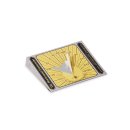
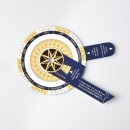
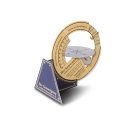
The quadrant is an astronomical instrument known since Babylonian antiquity. With the help of a plumb bob, it shows the angle between the rays of sight to a targeted point, e.g. a star, and the horizon point directly below it. One then speaks of the (angular) altitude or the elevation angle of this point or star. Thanks to a transversal division of the scale, the measurement succeeds to an accuracy of about 10 arc minutes. It is equipped with a sounding pipe and handle. This simple device is the historical predecessor of Jacob's staff and sextant.
How it works:
You determine any point in the sky (except the sun!) or in the landscape by taking a bearing through the tube. Hold the plumb line on the quadrant. You can read off the angle where the thread runs over the degree scale.
Very important: Never take a direct bearing on the sun! This can cause irreparable damage to your eyes!
If you still want to determine the altitude of the sun, this can be done as follows: Point the right end of the dipstick at the sun and hold the other end close over an inclined surface that catches the shadow of the quadrant, e.g. the palm of your hand. Then rotate the quadrant until its shadow has become a line and the sun can shine through the dipstick unhindered. Now the plumb line on the degree scale shows the angular height of the sun.
The pendulum quadrant is easy to build and is an excellent teaching aid for secondary schools. Like all other astro materials, it can also be used for other group and project work on astronomy and physics.
- Scope of delivery: Printed cut-out cardboard sheet for assembly with detailed assembly instructions.
- Size of the finished article: approx. 20 x 20 cm
- Little difficulty and time required
Product safety information
Manufacturer information:
Astromedia
Im Wirrigen 30
Waltrop, Deutschland, 45731
info@astromedia.de
There are no reviews yet.